

What is a Stepper Motor?
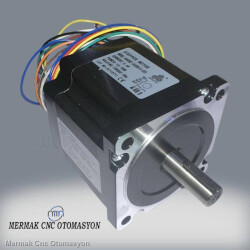
What is a Stepper Motor? Detailed Explanation
A stepper motor, often referred to as a step motor, is a brushless DC electric motor that divides a full rotation into a number of equal steps. The motor’s position can then be commanded to move and hold at one of these steps without any feedback sensor, as long as the motor is correctly sized for the application and the system is operating in an open-loop configuration. This fundamental characteristic makes stepper motors indispensable in applications requiring precise positioning and speed control, such as CNC machines, 3D printers, laser engravers, and robotic systems. Each pulse from a motor driver translates into a precise angular movement, ensuring high repeatability and accuracy.
How Stepper Motors Work: The Principle of Operation
The operation of a stepper motor relies on the interaction between a rotor with permanent magnets or soft iron teeth and a stator with multiple electromagnets. When the stator coils are sequentially energized by an external driver, they create a magnetic field that attracts the rotor’s teeth or poles, causing it to rotate by a specific angle, known as the step angle. This sequence of energizing and de-energizing coils allows the motor to move in discrete steps. By controlling the number and frequency of these electrical pulses, both the position and speed of the motor can be accurately managed. Advanced drivers can also implement microstepping, which further subdivides each full step into smaller increments, resulting in smoother motion and higher resolution.
Key Advantages of Stepper Motors in Automation
Stepper motors offer several distinct advantages that make them a preferred choice for many automation and motion control applications. Their primary benefit is the ability to achieve very precise positioning without the need for complex feedback mechanisms, thanks to their inherent discrete step movement. This simplifies control system design and reduces overall costs. They also exhibit excellent holding torque at standstill, allowing them to maintain a load’s position without continuous power consumption (in some cases). Stepper motors are highly reliable, robust, and can operate effectively in harsh industrial environments. Their digital nature makes them easily interfaced with microcontrollers and PLCs, providing seamless integration into modern automation architectures.
Types of Stepper Motors: Permanent Magnet, Variable Reluctance, and Hybrid
Stepper motors are generally categorized into three main types: permanent magnet (PM), variable reluctance (VR), and hybrid. Permanent magnet stepper motors utilize a permanent magnet rotor, which creates a strong magnetic field and good detent torque even when unenergized. Variable reluctance stepper motors feature a soft iron rotor with no permanent magnets, relying solely on the stator’s magnetic field to attract the rotor’s teeth to the lowest reluctance path. Hybrid stepper motors combine features of both PM and VR types, incorporating a toothed rotor with an axially magnetized permanent magnet. Hybrid steppers are the most common type due to their superior performance, offering higher torque, smaller step angles, and better dynamic characteristics compared to PM and VR motors, making them ideal for high-precision industrial applications.
Critical Parameters and Selection Criteria for Stepper Motors
Selecting the right stepper motor for an application involves considering several critical parameters. The step angle, typically ranging from 0.9° to 1.8°, determines the motor’s resolution; smaller angles mean finer control. Torque specifications, including holding torque, pull-in torque, and pull-out torque, are crucial for ensuring the motor can move and hold the intended load under various operating conditions. Current and voltage ratings must be matched with the capabilities of the stepper motor driver and power supply. Other important factors include rotor inertia, which affects acceleration and deceleration, and the motor’s physical dimensions and mounting options. Environmental considerations such as operating temperature, dust, and moisture also play a role in ensuring long-term reliability and performance.
Stepper Motor Drivers: Essential for Optimal Performance
A stepper motor is only as effective as the driver controlling it. Stepper motor drivers are electronic devices that translate control signals from a microcontroller or PLC into the precise current pulses required to energize the motor’s windings in the correct sequence. Modern drivers often incorporate advanced features such as microstepping, which allows for smoother motion, reduced resonance, and higher positional accuracy by dividing each full step into many smaller microsteps. They also provide current control, protecting the motor from overcurrent, and often include features like automatic current reduction at standstill to minimize heat generation. Proper selection of a stepper motor driver is paramount to unlock the full potential of the motor, ensuring optimal torque, speed, and precision for any motion control system.
Troubleshooting Common Stepper Motor Issues
While stepper motors are generally robust, users may encounter common issues such as missed steps, overheating, excessive vibration, or noise. Missed steps, leading to positional errors, can often be attributed to insufficient torque for the load, improper acceleration/deceleration settings, or inadequate current from the driver. Overheating might result from excessive current, high ambient temperatures, or continuous operation at high loads without sufficient cooling. Vibration and noise often stem from resonance issues, which can be mitigated by using microstepping drivers, adjusting step rates, or implementing anti-resonance features. Proper wiring, matching the motor and driver specifications, and ensuring a stable power supply are fundamental steps in preventing and resolving most stepper motor operational problems, ensuring reliable and precise motion control.
MERMAK CNC Difference: Superior Stepper Motor Solutions
At MERMAK CNC Automation, we offer a comprehensive range of high-performance stepper motors and integrated control solutions designed to meet the most demanding industrial applications. Our products stand out for their exceptional precision, robust reliability, and seamless integration capabilities, ensuring optimal performance for your CNC routers, laser machines, and custom automation projects. We pride ourselves on our engineering expertise and commitment to quality, providing solutions that drive efficiency and innovation. Our global reach extends through successful international sales, delivering MERMAK CNC’s cutting-edge technology worldwide. For detailed information, tailored solutions, and to explore how MERMAK CNC can elevate your automation needs, please contact us via WhatsApp at +905346585401. Let MERMAK CNC be your trusted partner in precision motion control.
Step Motor Nedir? SSS
What is a Stepper Motor?
A stepper motor is an electromechanical device that converts electrical pulses into discrete mechanical rotational steps. It is known for its ability to achieve precise positioning without the need for a feedback system, making it suitable for open-loop control applications.
How does a Stepper Motor work?
Stepper motors operate by energizing their internal coils (phases) in a specific sequence. This creates magnetic fields that attract or repel the rotor’s teeth, causing it to rotate in precise, fixed angular increments, known as steps.
What are the main advantages of Stepper Motors?
Key advantages include high precision in positioning, excellent holding torque at a standstill, robust performance in open-loop control systems, relatively lower cost compared to servo systems, and simple implementation with basic electronics.
What are the disadvantages of Stepper Motors?
Disadvantages include potentially high power consumption even when idle, susceptibility to resonance at certain speeds, risk of losing steps under excessive load or high acceleration, and generally lower efficiency at high speeds compared to servo motors.
Where are Stepper Motors commonly used?
Stepper motors are widely utilized in applications requiring precise motion control, such as 3D printers, CNC machines, robotics, industrial automation, medical equipment, camera pan/tilt systems, and precise fluid dispensing systems.
What are the different types of Stepper Motors?
The primary types of stepper motors are Permanent Magnet (PM), Variable Reluctance (VR), and Hybrid Synchronous. Hybrid motors combine features of both PM and VR types, offering improved performance and higher resolution.
What is Stepping Angle and Resolution in Stepper Motors?
The stepping angle is the angular displacement of the rotor for each single pulse applied to the motor. Resolution refers to the smallest increment of movement the motor can achieve, which can be improved significantly through microstepping techniques.
What is Microstepping and why is it used?
Microstepping is a technique that involves proportioning the current in the motor windings to achieve intermediate positions between full steps. It’s used to provide smoother motion, reduce resonance, decrease noise, and increase the positional accuracy of the motor.
How do you control a Stepper Motor?
Stepper motors are typically controlled by a dedicated driver circuit. This driver receives pulse signals (e.g., step and direction) from a microcontroller, PLC, or other control unit, which then sequences the current to the motor windings to dictate its movement.
What is Holding Torque in a Stepper Motor?
Holding torque is the maximum static torque a stepper motor can withstand without slipping or losing its position when it is energized and at a standstill. It’s a critical parameter for applications requiring the motor to maintain a fixed position against external forces.
Explain Pull-in Torque and Pull-out Torque.
Pull-in torque refers to the maximum torque a stepper motor can overcome without losing steps while accelerating from a stop to a given speed. Pull-out torque is the maximum torque it can overcome without losing steps once it is already running at a constant speed.
What are common problems encountered with Stepper Motors?
Common issues include lost steps (due to excessive load, acceleration, or insufficient current), resonance at specific operating speeds, overheating, and excessive noise or vibration. Proper motor and driver selection, along with tuning, can mitigate these problems.
How do you select the right Stepper Motor for an application?
Selecting the right stepper motor involves considering factors like required torque (holding, pull-in, pull-out), desired speed, positional accuracy (step angle, microstepping), motor size constraints, operating environment, and compatibility with the chosen driver and power supply.
Stepper Motor vs. Servo Motor: What’s the difference?
Stepper motors are open-loop systems offering precise discrete step control and high holding torque, suitable for fixed-position tasks. Servo motors are closed-loop systems with feedback, providing higher speed, continuous motion, dynamic torque, and better efficiency, often at a higher cost.
What are the main parameters to consider when selecting a Stepper Motor Driver?
Key parameters for driver selection include maximum output current per phase, operating voltage range, microstepping capabilities, built-in protection features (over-current, over-temperature), current decay modes, and the control interface (e.g., step/direction, SPI).